I'm eating moldy sawdust, or what the airline-issued cardboard box claims is coffee cake. "For those of you sitting on the left-hand side of the aircraft, you can see the lights of Havana, Cuba as we pass above it," the pilot announces. I glance outside, mid-bite.
I guess this is where I should be sentimental. I should reflect on my last six weeks in Peru and list the ways in which it has changed me. I should dedicate this blog to all that I will miss.
But that's not what I'm thinking right now as I look at Cuba.
CUBA. I'm out of Peru. I'm heading HOME.
I try to summon sentimentality, but it doesn't come.
Don't get me wrong - You would have to offer me a handsome sum to snatch these last six weeks away from me. I got to share an ecologist's enthusiasm for sticky liquids, to listen to an Amazon artisan sing native tales as she weaves her chambira, to play in a soup of tadpoles. I liked this adventure.
But all along, I knew I was going home. I came as a traveler, passing through moments of people's lives. I made friends, but I knew I would soon leave them. We would probably never see each other again. But knowing this made our limited time together better. We sang, we danced, we talked, and we didn't do it for a future friendship. All we had was this one song.
In Chino, Angel and I sang Te Amo by Makano until I could spit out all the lyrics with only minor slurring. On the airplane, I plug in my earphones and listen to Makano. "He's just not that into you" is playing on the TV above my seat, but I choose Makano. In this way, I wave good-bye to Peru. This is the extent of my sentimentality.
I feel heavy. I did not sleep last night. I went out to a karaoke bar and discoteca with Yully and Angel. And then it was 5 a.m. and I was taking a motorkar to the Iquitos airport.
Now I fall asleep to Cuba and Makano. "Espera, por favor no te vayas..."
This adventure was everything it should have been. I had fun. I was challenged. And now I have a new adventure waiting for me at home. I have a new apartment, five new classes, a new writing gig, several new bellydances to learn, a brother that's getting married in October, a mom with a new brick house, and Argentinian tango lessons with my Malibu.
"Ladies and gentlemen, the seatbelt sign is now on." New York's hodgepodge of lights stretches out below me. I'm HOME. My stomach lurches. Maybe it's excitement, or maybe it's the coffee cake.
Saturday, August 15, 2009

Monday, August 10, 2009
Intermission
Monday morning at sunrise our boat from Jenaro Herrera arrives in Iquitos. We hang around the city for four days. Campbell, Angel and Yully run a few distillations with the copal resin that we brought back from Jenaro Herrera. Copal smell saturates Campbell's hotel room (and hallway, and lobby).
Between experiments, Campbell runs around Iquitos in a hurried attempt to get an export permit. If he doesn't get all the paperwork signed and stamped before he leaves for Lima, he won't be able to take the hundreds of oil, resin and bug samples out of Peru. I intentionally distance myself from this process. The mind-numbing boredom of official-looking stacks of papers utterly terrifies me.
I eat a cone of coconut ice cream, every day.
I discuss roots and ocelot furs with the vendors of Belen and buy nine packs of mapacho (nicotiana rustica) cigars.
I spend an afternoon watching a street artist, Tomas, paint a Borra woman on a t-shirt. He sells each t-shirt for $15. He also creates bed-sized paintings, but he only works on those after taking ayahuaska. "When I have ayahuaska, I see the gods and godesses, " Tomas saya. "And that is what I put down on my canvas." In his paintings, frogs, raindroplets and nipples swirl out of rivers. Tomas tells me about his dead grandfather, who used to be a shaman. According to Tomas, his grandfather's bones continue to cure cancer patients. "My grandfather was like a god."
I watch a Hallmark movie dubbed in Spanish. The speakers' voices are all high-pitched and scratchy.
I spend $10 on Internet at a cafe that costs $0.70 per hour. I obviously miss my Internets, not to mention my Skype contacts.
Friday morning we leave for Chino, still fretting about signatures and still copying paperwork on our way to port.
Between experiments, Campbell runs around Iquitos in a hurried attempt to get an export permit. If he doesn't get all the paperwork signed and stamped before he leaves for Lima, he won't be able to take the hundreds of oil, resin and bug samples out of Peru. I intentionally distance myself from this process. The mind-numbing boredom of official-looking stacks of papers utterly terrifies me.
I eat a cone of coconut ice cream, every day.
I discuss roots and ocelot furs with the vendors of Belen and buy nine packs of mapacho (nicotiana rustica) cigars.
I spend an afternoon watching a street artist, Tomas, paint a Borra woman on a t-shirt. He sells each t-shirt for $15. He also creates bed-sized paintings, but he only works on those after taking ayahuaska. "When I have ayahuaska, I see the gods and godesses, " Tomas saya. "And that is what I put down on my canvas." In his paintings, frogs, raindroplets and nipples swirl out of rivers. Tomas tells me about his dead grandfather, who used to be a shaman. According to Tomas, his grandfather's bones continue to cure cancer patients. "My grandfather was like a god."
I watch a Hallmark movie dubbed in Spanish. The speakers' voices are all high-pitched and scratchy.
I spend $10 on Internet at a cafe that costs $0.70 per hour. I obviously miss my Internets, not to mention my Skype contacts.
Friday morning we leave for Chino, still fretting about signatures and still copying paperwork on our way to port.
Thursday, August 6, 2009
An update on CACE´s research: from weevils to bees
Every resin lump in the copal plantations at Jenaro Herrera has its story.
Angel Raygada (from Iquitos) and Milano and Itolo (two brothers from Jenaro Herrera) have been helping CACE write down these lump stories for more than three years.
CACE monitors about 170 copal trees at the station. I´ve chosen three lucky winners to introduce to you.
 That ball between the legs of this copal tree is an orchid bee nest. These green bees made this nest mostly out of copal resin, with a bit of mud mixed in.
Two months ago, Itolo spotted a green stingless bee on the nest. The bee crawled around the lump, left something (maybe resin?), and then buzzed away. This sighting is significant; we already knew that bees collect resin, but this is the first time we can correlate resin collection with nest building.
Yes, this bee actually is green! It's flashy like a disco ball.
 Angel and Itolo have been monitoring this tree for three years. They mark every resin lump with a white tag, as you see above. This big guy has 20 white tags, but no lumps. That's because someone stole all the lumps a few months ago, effectively trashing three years of data. The thieves probably used the resin to caulk their boat.
Goes to show that even protected research stations aren't always protected.
But this guy is making a comeback. Campbell and I found a live weevil inside one of the cone traps. This trap takes advantage of the insect's ability to climb upwards and inability to navigate steep downhills. The weevil climbed up into the trap through a hole, but now he can't get down through that same hole.
And that enables us to take a good look at him. He is candy-corn sized, with brown scaly legs and a chunky torso:

Number THREE
 This lump asks, "Can weevils and bees live together?"
The light brown patch is the remnant of a weevil respiratory tube. For four months, the weevil larvae would periodically stick their head through the thin film of resin at the end of the tube. After a few minutes, the larvae would slide back down the tube, creating suction, which in turn enabled the resin to flow back into the tube, sealing the entrance.
We assume that these weevil larvae navigate up and down the tube in order to catch a breath of air.
Two months ago, the respiratory tube closed. We think that the larvae are still inside, and that their mother is still feeding them. Campbell hypothesizes that the tube has closed because the larvae are now going through an advanced larvae instar (sub-stage).
(The scientific community still doesn't know much about the life cycle of the weevil. Hence, the abundance of assumptions, thoughts, and hypothesis.)
At about the same time that the respiratory tube closed, another tube formed on top of the lump. Itolo says that this structure looks like the entrance of an orchid bee nest.
Itolo is going to fasten a trap around the lump in order to catch any weevil or bee adults that emerge from the resin as they mature. Neither Itolo nor Campbell have ever seen a lump with both weevil and bee activity. This could be the first!
These lump stories don't directly affect our production of essential oil from copal resin. They are primarily for educational, not commercial, purposes.
These tales teach us more about the fascinating relationships among resin, weevils, bees and copal trees. They encourage us to question:
If we take away this resin, what else will we change indirectly?
When we pull on this small, knotted string, how many big strings do we pull with it?
If we take away our tropical forests, what happens to us?
Maybe not much, but maybe a lot.
We don't know, not yet.
These lumps add to our understanding of ecology, of how our world works, of us.
Angel Raygada (from Iquitos) and Milano and Itolo (two brothers from Jenaro Herrera) have been helping CACE write down these lump stories for more than three years.
CACE monitors about 170 copal trees at the station. I´ve chosen three lucky winners to introduce to you.
Number ONE
 That ball between the legs of this copal tree is an orchid bee nest. These green bees made this nest mostly out of copal resin, with a bit of mud mixed in.
Two months ago, Itolo spotted a green stingless bee on the nest. The bee crawled around the lump, left something (maybe resin?), and then buzzed away. This sighting is significant; we already knew that bees collect resin, but this is the first time we can correlate resin collection with nest building.
Yes, this bee actually is green! It's flashy like a disco ball.


Number TWO
 Angel and Itolo have been monitoring this tree for three years. They mark every resin lump with a white tag, as you see above. This big guy has 20 white tags, but no lumps. That's because someone stole all the lumps a few months ago, effectively trashing three years of data. The thieves probably used the resin to caulk their boat.
Goes to show that even protected research stations aren't always protected.
But this guy is making a comeback. Campbell and I found a live weevil inside one of the cone traps. This trap takes advantage of the insect's ability to climb upwards and inability to navigate steep downhills. The weevil climbed up into the trap through a hole, but now he can't get down through that same hole.
And that enables us to take a good look at him. He is candy-corn sized, with brown scaly legs and a chunky torso:

Number THREE
 This lump asks, "Can weevils and bees live together?"
We assume that these weevil larvae navigate up and down the tube in order to catch a breath of air.
Two months ago, the respiratory tube closed. We think that the larvae are still inside, and that their mother is still feeding them. Campbell hypothesizes that the tube has closed because the larvae are now going through an advanced larvae instar (sub-stage).
(The scientific community still doesn't know much about the life cycle of the weevil. Hence, the abundance of assumptions, thoughts, and hypothesis.)
At about the same time that the respiratory tube closed, another tube formed on top of the lump. Itolo says that this structure looks like the entrance of an orchid bee nest.
Itolo is going to fasten a trap around the lump in order to catch any weevil or bee adults that emerge from the resin as they mature. Neither Itolo nor Campbell have ever seen a lump with both weevil and bee activity. This could be the first!
These lump stories don't directly affect our production of essential oil from copal resin. They are primarily for educational, not commercial, purposes.
These tales teach us more about the fascinating relationships among resin, weevils, bees and copal trees. They encourage us to question:
If we take away this resin, what else will we change indirectly?
When we pull on this small, knotted string, how many big strings do we pull with it?
If we take away our tropical forests, what happens to us?
Maybe not much, but maybe a lot.
We don't know, not yet.
These lumps add to our understanding of ecology, of how our world works, of us.
Meet Edith
Edith Ramirez dips a blade of grass into yellow paint and squiggles feathers on an owl carved out of balsa wood. Edith specializes in painting earrings because she likes "all the little things in life," she says.
Before Edith joined the Kolping artisan association at Jenaro Herrera, she lived according to a timeline of big things, not little.
At age 17, Edith decided to become a nun. She joined a monastery in Lima, but then quit four years later. "There were too many rules," Edith says.
Edith moved to Pucallpa (a jungle city notorious for crime and drug trafficking), got a boyfriend, and worked in a book store. During the workday, she lost herself in mystery and romance novels. "But of course, the Bible was still my favorite book," Edith says. "It tells you everything."
At the time, Edith did not know that her boyfriend, Arturo Pizarro, was a leader of Sendero Luminoso, a Peruvian terrorist organization.
One evening, Edith was walking home from the bookstore when two men on motorcycles pulled up alongside her. They threatened to kill Edith if she did not come with them. The men locked Edith in a dark room for three days without food or drink.
When they released her, the men said, "You can go, because your lover gave us what we wanted."
That was 14 years ago. Edith never saw her boyfriend again. She assumes that he is dead.
Afraid that her life was still in danger, Edith fled to Jenaro Herrera, her hometown. She made a living by painting toucans and selling them to tourists.
"When I paint, I relax," Edith says.
Edith is determined to not die "just an artisan."
Edith´s dream is to build a pharmacy in Jenaro Herrera. According to Edith, the government clinic lacks basic medicine. In the last two years, three people have died of snake bites because the clinic did not have anti-venom in stock.
"I will give them anti-venom. It´s that simple," Edith says.
Edith hangs the owl earrings to dry in the sun on a clothesline, along with 10 other owls.
She sells the earrings for four soles per pair. The license for her dream pharmacy costs 3000 soles. "That's 750 pairs of earrings. 1,500 owls, snakes and toucans," Edith calculates. "Not bad."
Before Edith joined the Kolping artisan association at Jenaro Herrera, she lived according to a timeline of big things, not little.
At age 17, Edith decided to become a nun. She joined a monastery in Lima, but then quit four years later. "There were too many rules," Edith says.
Edith moved to Pucallpa (a jungle city notorious for crime and drug trafficking), got a boyfriend, and worked in a book store. During the workday, she lost herself in mystery and romance novels. "But of course, the Bible was still my favorite book," Edith says. "It tells you everything."
At the time, Edith did not know that her boyfriend, Arturo Pizarro, was a leader of Sendero Luminoso, a Peruvian terrorist organization.
One evening, Edith was walking home from the bookstore when two men on motorcycles pulled up alongside her. They threatened to kill Edith if she did not come with them. The men locked Edith in a dark room for three days without food or drink.
When they released her, the men said, "You can go, because your lover gave us what we wanted."
That was 14 years ago. Edith never saw her boyfriend again. She assumes that he is dead.
Afraid that her life was still in danger, Edith fled to Jenaro Herrera, her hometown. She made a living by painting toucans and selling them to tourists.
"When I paint, I relax," Edith says.
Edith is determined to not die "just an artisan."
Edith´s dream is to build a pharmacy in Jenaro Herrera. According to Edith, the government clinic lacks basic medicine. In the last two years, three people have died of snake bites because the clinic did not have anti-venom in stock.
"I will give them anti-venom. It´s that simple," Edith says.
Edith hangs the owl earrings to dry in the sun on a clothesline, along with 10 other owls.
She sells the earrings for four soles per pair. The license for her dream pharmacy costs 3000 soles. "That's 750 pairs of earrings. 1,500 owls, snakes and toucans," Edith calculates. "Not bad."
The Unheard
11 p.m., and my eyes won´t close. I flick on my headlamp, and a cockroach waves "hello!" to me with his meandering antennae.
He freezes to let me get a good look at him. "If Yully were here, she would stomp you into a pancake with her rubber boot," I tell him. The antennae laugh.
You´re right, I won´t kill you because I don´t want to get my boot dirty with your goo. Better moving and solid than still and gooey, I reason.
This cockroach would be beautiful if he wasn´t creepy, disgusting and the length of my middle finger. He shines back like a mahogany coffee table accented with yellow crayon doodles.
I spot his friend on the cement floor. She is coffee and milk with flecks of black coffee grinds.
OK, seven more hours until daylight, and I need a new hobby.
I crack open The Unheard: a memoir of deafness and Africa by John Swiller.
The title sounds heavy. I expect it to try to guilt trip me into feeling sorry for Africa and deaf people, and then to remind me about how beautiful poor communities really are! I´m already mad at Josh because he´s about to transform that stupid infommercial -- the one with that old, white guy and skinny, sad African girl -- into a 265-page rant, and I´m not in the mood. You´re not going to make me get all depressed about the state of the world, Josh!
Josh shuts me up once I start reading the book. I´m happy to say that he does not live up to any of my expectations.
The Unheard isn´t so much about deafness or Africa, as it is about dealing with people in general, and coming to terms with yourself. Josh arrives in Zambia as a (sorta) deaf Peace Corps volunteer with high hopes to "save" Africa. But all of his projects fail. He spends most of his time arguing with the community headmen, playing chess, weighing babies at the town clinic, and sharing Playboy with his friends.
Josh tells his story with lots of periods and quotation marks; his sentences are witty and short, with the perfect degree of descriptive.
Josh doesn´t offer us any great insight into the state of humanity. He doesn´t pretend to know more about the world than the average reader (me). In this way, the book feels like a conversation.
I´m itching to share the last sentence of the book (my favorite), but I don´t want to ruin the ending for you.
Sucky title, great read.
The antennae wiggle in agreement, and the night exhales with daybreak.
He freezes to let me get a good look at him. "If Yully were here, she would stomp you into a pancake with her rubber boot," I tell him. The antennae laugh.
You´re right, I won´t kill you because I don´t want to get my boot dirty with your goo. Better moving and solid than still and gooey, I reason.
This cockroach would be beautiful if he wasn´t creepy, disgusting and the length of my middle finger. He shines back like a mahogany coffee table accented with yellow crayon doodles.
I spot his friend on the cement floor. She is coffee and milk with flecks of black coffee grinds.
OK, seven more hours until daylight, and I need a new hobby.
I crack open The Unheard: a memoir of deafness and Africa by John Swiller.
The title sounds heavy. I expect it to try to guilt trip me into feeling sorry for Africa and deaf people, and then to remind me about how beautiful poor communities really are! I´m already mad at Josh because he´s about to transform that stupid infommercial -- the one with that old, white guy and skinny, sad African girl -- into a 265-page rant, and I´m not in the mood. You´re not going to make me get all depressed about the state of the world, Josh!
Josh shuts me up once I start reading the book. I´m happy to say that he does not live up to any of my expectations.
The Unheard isn´t so much about deafness or Africa, as it is about dealing with people in general, and coming to terms with yourself. Josh arrives in Zambia as a (sorta) deaf Peace Corps volunteer with high hopes to "save" Africa. But all of his projects fail. He spends most of his time arguing with the community headmen, playing chess, weighing babies at the town clinic, and sharing Playboy with his friends.
Josh tells his story with lots of periods and quotation marks; his sentences are witty and short, with the perfect degree of descriptive.
Josh doesn´t offer us any great insight into the state of humanity. He doesn´t pretend to know more about the world than the average reader (me). In this way, the book feels like a conversation.
I´m itching to share the last sentence of the book (my favorite), but I don´t want to ruin the ending for you.
Sucky title, great read.
The antennae wiggle in agreement, and the night exhales with daybreak.
Tuesday, August 4, 2009
What $170 does
CACE gives 20% of its handicraft sales back to the community. This year, the artisans of Jenaro Herrera earned 500 soles, or about $170, for their town´s school.
Campbell asked Elox Pacaxa, principal of Jenaro Herrera school, what his school needed, and Elox drafted a wish list.
We bought most of the items at Jenaro Herrera´s biggest general store -- the kind of place that sells cake, cola, t-shirts on robocop manequinns, butter by the spoonful, notebooks, machetes and miscellaneous buttons in four-liter jugs.
Elox read his wish list to the store owner (shirtless, with hairy nipples).

This is what $170 buys at Jenaro Herrera:
1 Hewlett Packard printer
3 ink cartridges for printer
3000 pages of computer paper
2 dozen bottles of toilet cleaner
2 dozen brooms
500 pages of drawing paper
48 packets of ACE detergent
1 kilogram of rubber cement
2 locks
10 colored poster boards
20 pills for pain and infections
5 packets of Vick´s vapor rub
1bottle of disinfectant
1 white-out pen
3 pens

Campbell asked Elox Pacaxa, principal of Jenaro Herrera school, what his school needed, and Elox drafted a wish list.
We bought most of the items at Jenaro Herrera´s biggest general store -- the kind of place that sells cake, cola, t-shirts on robocop manequinns, butter by the spoonful, notebooks, machetes and miscellaneous buttons in four-liter jugs.
Elox read his wish list to the store owner (shirtless, with hairy nipples).

This is what $170 buys at Jenaro Herrera:
1 Hewlett Packard printer
3 ink cartridges for printer
3000 pages of computer paper
2 dozen bottles of toilet cleaner
2 dozen brooms
500 pages of drawing paper
48 packets of ACE detergent
1 kilogram of rubber cement
2 locks
10 colored poster boards
20 pills for pain and infections
5 packets of Vick´s vapor rub
1bottle of disinfectant
1 white-out pen
3 pens

What happened to my windows
In four days at Jenaro Herrera field station, I broke two windows in my house, intentionally.
This research station is made with the needs and wants of scientists in mind. I get my own house, with a splotchy mirror, electricity for four hours each evening, a toilet that usually flushes, and three empty bedrooms. I think all the space is for my nonexistent equipment and experiments.
And I get two locks -- one for my bedroom, and the other for the front door -- and four keys.
The locks and keys are what did it.
You see, I am not a scientist. When my bedroom doorknob fell off and tumbled into a spiderweb (with spider), I did not fix it. I left it there.
I watched the spider explore the remnants of her web. She peeked into the cavity of the knob, obviously more curious than distraught in the face of destruction. I sketched the inquisitive creature on a square of toilet paper. Then my attention wavered, and I drew how the torn, lacy curtain plasters against my window in the late afternoon.
And then I left for dinner.
Since I am not a scientist, I did not contemplate the inner workings of the lock. I left my bedroom keys in my bedroom, assuming that a broken lock does not lock.
Obviously, the broken lock locked.
The groundskeeper did not have a spare. He had attached the spare to the original "to better keep track of it." He handed me a hammer, pointed to the window, and said that he would be back in a few minutes to help me in. I did not wait, because "a few" in Peruvian time means half an hour in Natalya time.
Clearly, this story would be much more dramatic if the window were made out of glass. But I just had to lift a few wooden planks and rip through the mosquito netting. They shouldn´t even bother with the locks.
As I swung my legs into the house, a clump of researchers passed by my house. Two of them noted my flailing silouhette, and the whites of their eyes popped. They quickened their step. If they realized that someone was breaking in, they never let on.
I climbed in, tangled my feet in the lacy curtain, tripped, and crushed my curious spider friend.
I drew her furry brown legs, crisscrossed.
The next day, I repeated this exercise with the front door. I am not a scientist, and I do not stive for efficiency.
This research station is made with the needs and wants of scientists in mind. I get my own house, with a splotchy mirror, electricity for four hours each evening, a toilet that usually flushes, and three empty bedrooms. I think all the space is for my nonexistent equipment and experiments.
And I get two locks -- one for my bedroom, and the other for the front door -- and four keys.
The locks and keys are what did it.
You see, I am not a scientist. When my bedroom doorknob fell off and tumbled into a spiderweb (with spider), I did not fix it. I left it there.
I watched the spider explore the remnants of her web. She peeked into the cavity of the knob, obviously more curious than distraught in the face of destruction. I sketched the inquisitive creature on a square of toilet paper. Then my attention wavered, and I drew how the torn, lacy curtain plasters against my window in the late afternoon.
And then I left for dinner.
Since I am not a scientist, I did not contemplate the inner workings of the lock. I left my bedroom keys in my bedroom, assuming that a broken lock does not lock.
Obviously, the broken lock locked.
The groundskeeper did not have a spare. He had attached the spare to the original "to better keep track of it." He handed me a hammer, pointed to the window, and said that he would be back in a few minutes to help me in. I did not wait, because "a few" in Peruvian time means half an hour in Natalya time.
Clearly, this story would be much more dramatic if the window were made out of glass. But I just had to lift a few wooden planks and rip through the mosquito netting. They shouldn´t even bother with the locks.
As I swung my legs into the house, a clump of researchers passed by my house. Two of them noted my flailing silouhette, and the whites of their eyes popped. They quickened their step. If they realized that someone was breaking in, they never let on.
I climbed in, tangled my feet in the lacy curtain, tripped, and crushed my curious spider friend.
I drew her furry brown legs, crisscrossed.
The next day, I repeated this exercise with the front door. I am not a scientist, and I do not stive for efficiency.
Belen, the underworld of Iquitos
In Belen, boys run around barefoot, clutching kites fashioned out of plastic bags. Girls skip down the road, holding hands. They fall on grass, still holding hands.
It smells heavy here, like warm worms.


Michael, Randy and I are drinking "negritas" (coke) with purple straws from glass bottles. Michael buys a round of negritas for our new friends: 26-year-old Lito, his father Pedro, and his uncle Arturo.
The three men live together in a house on stilts that cost them 300 soles ($100).
 Belen is where you go in Iquitos when you have nowhere else to go. It is literally the underworld of the city; when the river rises, Belen and its homes on stilts go under.
Here you poop in your outhouse on the river, and you drink the river, too. Ten thousand people live here.
 Pedro moved here from Padre Isla, a small village downriver from the city. At age 15, he started washing dishes in the market.
Lito was born and raised on this same piece of land. He now gives tours of his home and river to passersby. Lito is proud of his neighborhood on stilts. He points and smiles and shows Belen off as if it were Venice. (It is almost like Venice --- same smell, different architecture.)
Michael and Arturo poke fun at each other. Their voices thunder and their stomachs shake. Pedro and Lito join in, giggling.
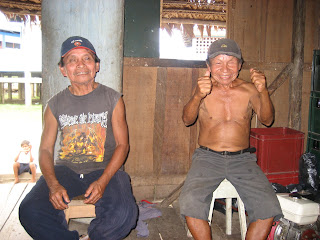 Our straws gurgle, lapping up last drips of black, and we hug, and we say good-bye, as if we were more than mere acquaintances. We shared a laugh in Belen.
On our way out, Belen asks me for sex at least three times and woes me with a drunken love song. Belen steals Randy´s hat off his head, while he is sitting in a moving motorcar.
This place is poor, underdeveloped and dangerous, no doubt. And the kids are skipping, and grown men are giggling. Like all of the places I´ve visited in Peru, Belen doesn´t let me form an opinion about it.
It is bad, good, and it is.
It smells heavy here, like warm worms.


Michael, Randy and I are drinking "negritas" (coke) with purple straws from glass bottles. Michael buys a round of negritas for our new friends: 26-year-old Lito, his father Pedro, and his uncle Arturo.
The three men live together in a house on stilts that cost them 300 soles ($100).
 Belen is where you go in Iquitos when you have nowhere else to go. It is literally the underworld of the city; when the river rises, Belen and its homes on stilts go under.
Here you poop in your outhouse on the river, and you drink the river, too. Ten thousand people live here.
 Pedro moved here from Padre Isla, a small village downriver from the city. At age 15, he started washing dishes in the market.
Lito was born and raised on this same piece of land. He now gives tours of his home and river to passersby. Lito is proud of his neighborhood on stilts. He points and smiles and shows Belen off as if it were Venice. (It is almost like Venice --- same smell, different architecture.)
Michael and Arturo poke fun at each other. Their voices thunder and their stomachs shake. Pedro and Lito join in, giggling.
 Our straws gurgle, lapping up last drips of black, and we hug, and we say good-bye, as if we were more than mere acquaintances. We shared a laugh in Belen.
On our way out, Belen asks me for sex at least three times and woes me with a drunken love song. Belen steals Randy´s hat off his head, while he is sitting in a moving motorcar.
This place is poor, underdeveloped and dangerous, no doubt. And the kids are skipping, and grown men are giggling. Like all of the places I´ve visited in Peru, Belen doesn´t let me form an opinion about it.
It is bad, good, and it is.
Tuesday, July 28, 2009
I miss Yully.
As the Maijuna Congress dragged into day three, hour five, and as we both began to slouch over in our toddler-sized seats and nod into a slumber, Yully and I woke each other up by whispering about our perfect ice cream sundae.
We agreed on chocolate ice cream with chocolate chips and fudge drizzle in a waffle cone. "And it would be as big as my head!" Yully added. A few hours later, we added a strawberry on top of our fantasy.
And as the congress continued to day three, hour eight, I drew a picture biography of Yully in blue pen, pencil stub and squeaky pink highlighter. Her eyes are uncomfortably wide open, as if someone is prying them up with matches. Her head is in profile, and her nose points longingly to a patch of trees, dirt and open sky. Her neck dissolves into a river filled with butterflies, chocolate bars, dancing feet, clapping hands, and a big chocolate ice cream in a waffle cone.
"Exactly," Yully whispers.
* * *
As we floated down the Napo River in an elongated canoe (hour 15 of 27), Yully flicked her wrist, and I understood. Time to switch seats.
I had been trying to fall asleep on a sugar sack encrusted in ants, and Yully had been using an orange lifejacket as a pillow. She was convincing her neck and back to conform to the 90 degree seat angle. Neither of us had succeeded in catching a wink of sleep, so we switched. The life jacket looked exceptionally comfortable to me, and Yully eyed my sugar sack with envy.
The lifejacket was hard like plywood and it rustled every time I turned my neck. The ants on the sack snapped at Yully´s shoulder blades.
So we both gave up on sleep and sang instead.
"Hoy yo conoci / un cielo de sol / noche sin suenos / rio de sal / y un barco abandonado en el desierto..."
In order to outdo the hum of the motor, we sang loudly and together. We filled the river with love, change and Shakira.
* * *
A month ago, I was on board a boat to Brillo Nuevo that wasn´t destined to arrive in Brillo Nuevo anytime soon. Yully had just joined our team of three, and I approached her with a handshake. As we talked that night, I interlaced niceties with questions - I wanted to know her stats, just in case I needed to include them in a blog or article. I wrote them down on a piece of brown scratch paper that I tucked away in my notebook:
Yully is spelled Y-U-L-L-Y, even though it sounds like "Julie" to me. Yully, 37, is an agronomist, which means that she studies plants. Yully helps us out in the field. She is from Iquitos, Peru, born and raised. And she has two daughters, ages 6 and 13.
I was the journalist, and she was my subject. We weren´t friends yet, so that bland relationship was still possible.
* * *
A month later, Yully and I talked through the night about love, change and Shakira, but I would never repeat that here. I can´t write a story about her now. That would be disrespectful to my friend.
As soon as my story subject becomes my friend, I´ve lost my story. That´s a painful realization - that actually getting to know someone, that catching a glimpse of what they mull over when they stare blankly into the river, isn´t in your best interest as a journalist.
Yully is not accompanying us on this upcoming expedition to Jenaro Herrera.
* * *
And I miss her.
We agreed on chocolate ice cream with chocolate chips and fudge drizzle in a waffle cone. "And it would be as big as my head!" Yully added. A few hours later, we added a strawberry on top of our fantasy.
And as the congress continued to day three, hour eight, I drew a picture biography of Yully in blue pen, pencil stub and squeaky pink highlighter. Her eyes are uncomfortably wide open, as if someone is prying them up with matches. Her head is in profile, and her nose points longingly to a patch of trees, dirt and open sky. Her neck dissolves into a river filled with butterflies, chocolate bars, dancing feet, clapping hands, and a big chocolate ice cream in a waffle cone.
"Exactly," Yully whispers.
* * *
As we floated down the Napo River in an elongated canoe (hour 15 of 27), Yully flicked her wrist, and I understood. Time to switch seats.
I had been trying to fall asleep on a sugar sack encrusted in ants, and Yully had been using an orange lifejacket as a pillow. She was convincing her neck and back to conform to the 90 degree seat angle. Neither of us had succeeded in catching a wink of sleep, so we switched. The life jacket looked exceptionally comfortable to me, and Yully eyed my sugar sack with envy.
The lifejacket was hard like plywood and it rustled every time I turned my neck. The ants on the sack snapped at Yully´s shoulder blades.
So we both gave up on sleep and sang instead.
"Hoy yo conoci / un cielo de sol / noche sin suenos / rio de sal / y un barco abandonado en el desierto..."
In order to outdo the hum of the motor, we sang loudly and together. We filled the river with love, change and Shakira.
* * *
A month ago, I was on board a boat to Brillo Nuevo that wasn´t destined to arrive in Brillo Nuevo anytime soon. Yully had just joined our team of three, and I approached her with a handshake. As we talked that night, I interlaced niceties with questions - I wanted to know her stats, just in case I needed to include them in a blog or article. I wrote them down on a piece of brown scratch paper that I tucked away in my notebook:
Yully is spelled Y-U-L-L-Y, even though it sounds like "Julie" to me. Yully, 37, is an agronomist, which means that she studies plants. Yully helps us out in the field. She is from Iquitos, Peru, born and raised. And she has two daughters, ages 6 and 13.
I was the journalist, and she was my subject. We weren´t friends yet, so that bland relationship was still possible.
* * *
A month later, Yully and I talked through the night about love, change and Shakira, but I would never repeat that here. I can´t write a story about her now. That would be disrespectful to my friend.
As soon as my story subject becomes my friend, I´ve lost my story. That´s a painful realization - that actually getting to know someone, that catching a glimpse of what they mull over when they stare blankly into the river, isn´t in your best interest as a journalist.
Yully is not accompanying us on this upcoming expedition to Jenaro Herrera.
* * *
And I miss her.
Don´t trust the juice
I downed three glasses of fruit juice from a street vendor yesterday. I chose to ignore the fact that the "juice" was mostly just river water. I had been in the field for almost two weeks, and I was immune to such silly matters like brown water.
Or so I thought. You see where this is going.
A few hours later, I ate at a chicken restaurant in Iquitos. On the way out of the restaurant, I stepped into the bathroom and vomitted a sinkful of chicken and pink stuff. I recognized that color -- that fruit juice had betrayed me!
I tapped a waitress on the shoulder. "Excuse me, I´m sorry, but your sink is now filled with pink."
I write way too much about body fluids. I´ll try to spare you next time.
In the rainforest
I spy:
"Chapaja," a tree the color of roadside snow. Locals burn its trunk, soak the ashes in water, and use the product as a salt substitute.
"Ungurawi," acorn-sized fruit that turn black when ripe. They taste best when swirled into ice cream.
"Wangbet," a vine that smells like passion fruit when you cut it open. Some indigenous groups use its coarse fibers to weave "paneras," or shallow baskets.
"Barandilla," a plant with a strong and pliable stem. Cut the branches off, and it makes for a great fishing pole.
"Irapai," a plant with clumps of four shinbone-sized palm leaves. The Maijuna weave these clumps of leaves around a branch to make their roofs. Their criss-cross design ensures impermeability.
"Wangana" (peckery), a wild pig that squeals, grunts, and scurries as it approaches a "colpa," a nutrient-rich watering hole. These black beasts thump through the jungle in groups of up to 200.
"Chapaja," a tree the color of roadside snow. Locals burn its trunk, soak the ashes in water, and use the product as a salt substitute.
"Ungurawi," acorn-sized fruit that turn black when ripe. They taste best when swirled into ice cream.
"Wangbet," a vine that smells like passion fruit when you cut it open. Some indigenous groups use its coarse fibers to weave "paneras," or shallow baskets.
"Barandilla," a plant with a strong and pliable stem. Cut the branches off, and it makes for a great fishing pole.
"Irapai," a plant with clumps of four shinbone-sized palm leaves. The Maijuna weave these clumps of leaves around a branch to make their roofs. Their criss-cross design ensures impermeability.
"Wangana" (peckery), a wild pig that squeals, grunts, and scurries as it approaches a "colpa," a nutrient-rich watering hole. These black beasts thump through the jungle in groups of up to 200.
The Maijuna and the Bora: a comparison
After the Maijuna Congress, we traveled to Nueva Vida, one of the four Maijuna villages.
Nueva Vida is different than Brillo Nuevo, the Bora village we visited on our last expedition. Here´s how:
Brillo Nuevo: Each family has a latrine. Behind the school, there are four “upgraded” latrines with ceramic toilet seats.
Nueva Vida: We pee and poop in the woods behind the house. As I crouch, the pigs encircle me and grunt. Then they dig their faces into my excrements.
Brillo Nuevo: Everyone drinks clean water from a well. Some bathe with rainwater collected from the school´s roof.
Nueva Vida: Everyone bathes in the river. They wash pig and cow poop into the river. They drink from the river.
Brillo Nuevo: There are pigs, but I never saw them because they were corralled and separated from the village.
Nueva Vida: The pigs, dogs, cats, roosters and chickens all live under the house. The lawn is a muddy, poopy slush.
Brillo Nuevo: Everyone speaks Bora amongst themselves.
Nueva Vida: Everyone speaks Spanish. The older generation knows Maijuna, but most of the children never learned their parent´s native tongue.
Brillo Nuevo: There´s a school with five teachers that regularly hold class.
Nueva Vida: There´s a teacher, but he rarely bothers to visit the village. He lives in Iquitos and collects his paycheck there. The children here have not gone to school for three years. They spend their days playing soccer, fishing, chucking bottle caps and splashing in the river.
The Maijuna know what they´re missing out on. They want their children to drink clean water and go to school. They want change, but they´re not sure about how to bring it about.
For the last several hundred years, foreigners have played with the destinies of both the Maijuna and the Bora. Strangers enslaved them. They grouped them into villages to better control them. They made them believe in a god and a book that was not their god, and was certainly not their book. Foreigners told them what was right and wrong. They stripped them of their culture, and then they left them.
Looks like the Maijuna were destined for the shorter end of the stick.
Yo hablo castellano, por supuesto
I woke up last night at 2am, hungry and furious. I had fallen asleep at 6pm yesterday and no one had woken me up for dinner. And now my stomach was GROOooWLing.
I huffed and puffed in my hammack, and then fell back to sleep until sunrise.
As soon as I woke up, I was confrontational Natalya. Why did you not wake me up?!!
"Oh, but I did," Yully said (in Spanish). "You murmured, ´Oh Yully, not now, maybe in another hour, go away.´" (in Spanish)
I slept-talked in Spanish! That can only mean that my Spanish conversational skills are undoubtedly improving! My subconscious is eating up this new language.
Forget the empty stomach - I am so impressed with myself.
(Sorry for flipping out, Yully.)
I huffed and puffed in my hammack, and then fell back to sleep until sunrise.
As soon as I woke up, I was confrontational Natalya. Why did you not wake me up?!!
"Oh, but I did," Yully said (in Spanish). "You murmured, ´Oh Yully, not now, maybe in another hour, go away.´" (in Spanish)
I slept-talked in Spanish! That can only mean that my Spanish conversational skills are undoubtedly improving! My subconscious is eating up this new language.
Forget the empty stomach - I am so impressed with myself.
(Sorry for flipping out, Yully.)
The first step
Only now do I realize that I walked in on the middle of a project in Brillo Nuevo. Campbell had already visited the village several times. The artisans agreed to talk to me for hours about their personal lives because Campbell had already built relationships with them. They trusted us.
That´s not the case in Nueva Vida. Not yet.
The women here do not consider themselves to be artisans. Most of the women, and even some of the men and children, have weaved a hammock out of chambira before. But they are reluctant to tackle new projects, like belts and shopping bags.
I stop by each of the houses in the village and introduce myself. "I am Natalya from CACE, a small NGO in the US. You´ve probably already met the tall white guy with gray hair. He´s the president of CACE..."
After my speach, I ask them if they have any interest in making handicrafts to sell in the Amazon Forest Store. They stare back at me. Then they glance at each other, as if to ask, "Why is this girl still in our home?"
That´s not the case in Nueva Vida. Not yet.
The women here do not consider themselves to be artisans. Most of the women, and even some of the men and children, have weaved a hammock out of chambira before. But they are reluctant to tackle new projects, like belts and shopping bags.
I stop by each of the houses in the village and introduce myself. "I am Natalya from CACE, a small NGO in the US. You´ve probably already met the tall white guy with gray hair. He´s the president of CACE..."
After my speach, I ask them if they have any interest in making handicrafts to sell in the Amazon Forest Store. They stare back at me. Then they glance at each other, as if to ask, "Why is this girl still in our home?"
So I explain everything again, and then again with extra details. They nod. I ask if they have any questions.
No questions, but they thank me for stopping by and ask when I will come back. "And could you visit my sister´s house, too?"
I think I broke the ice.
I am a magnet for 16-year-old girls
These girls follow me around with strings of questions. Today the girl was Kelly.
When I sat down in a peque-peque to visit some artisans in a nearby village, Kelly´s polka dot leggings squeezed in beside me. And she began:
I like your arm hair.
Do you dye your arm hair?
Have you ever been drunk?
Is your country by Africa?
How many kids do you want to have?
Is Charlie from Charlie´s Angels dead?
Why did Michael Jackson die?
And so I learned that Kelly, who lives five hours by peque-peque from the nearest tabloid, knows more about American pop culture than I do.
Michael Jackson died?
When I sat down in a peque-peque to visit some artisans in a nearby village, Kelly´s polka dot leggings squeezed in beside me. And she began:
I like your arm hair.
Do you dye your arm hair?
Have you ever been drunk?
Is your country by Africa?
How many kids do you want to have?
Is Charlie from Charlie´s Angels dead?
Why did Michael Jackson die?
And so I learned that Kelly, who lives five hours by peque-peque from the nearest tabloid, knows more about American pop culture than I do.
Michael Jackson died?
The Maijuna Congress
Just last month, Peruvian police violently attacked indigenous protesters, killing at least 25 civilians. In response, government officials publicly condemned indigenous people to second-class citizenship.
So it's significant that, in this hostile climate, the Maijuna chose to unite and fight for their rights. Four years ago, the small ethnic group of about 250 people formed a federation---nicknamed "FECONAMAI"--- that represents all four Maijuna villages. Since then, the Maijuna have come together annually to share problems, brainstorm solutions, and play soccer.
So it's significant that, in this hostile climate, the Maijuna chose to unite and fight for their rights. Four years ago, the small ethnic group of about 250 people formed a federation---nicknamed "FECONAMAI"--- that represents all four Maijuna villages. Since then, the Maijuna have come together annually to share problems, brainstorm solutions, and play soccer.
At this year's congress, more than 120 people gather for three days in the half-built community center in the Maijuna village of Sucusari. As they talk, construction workers bang bricks and scrape mortar. Children flick bottle caps in the doorway. Just outside, a woman chases a cow that sprints away with a purple skirt in its mouth. Whenever it rains, the drops create such a racket against the roof's tin shingles that the speakers are forced to break for the storm, trailing off mid-sentence.
The main topic of conversation is the proposed Maijuna Area of Conservation. This legal designation has the potential to protect the Maijuna lands forever, thereby revitalizing fish populations and decreasing deforestation.
Several local and international groups support the Maijuna's efforts to protect their traditional lands, including Procrel, a regional government organization, and IBC, an NGO founded by an American anthropologist. This summer, the Field Museum of Chicago is carrying out an assessment of the biodiversity and depth of Maijuna culture in the proposed area. The Maijuna hope that the assessment will convince regional government officials that their land is too important to be destroyed.
But the Maijuna are fighting an uphill battle. The government is considering a proposal to build a road that would cut through the Maijuna territory. Five kilometers of agricultural lands would flank each side of the road, effectively wiping out the lands of the Maijuna.
The construction of the road is considered a national priority, which means it overrides all other interests, including the regional Maijuna Area of Conservation. According to ethnobotanist Michael Gilmore, the road is being pushed by (illegal) loggers and (illegal) drug traffickers who are tired of walking through the forest on foot.
At the congress, the Maijuna practice patience and resilience. Romero Rios, president of FECONAMAI, punches the air and says in Spanish, "Let's always walk. Let's always lose time. But let's never lose our animals."
chupar y soplar
"Tu-te, this will protect you during your next journey on the river and through the jungle," says Pedro. Tu-te is my Maijuna name. It means "white dove."
Pedro´s voice clinks like metal chains on an empty swing set. He traces my bare back with a fistful of achiote leaves. They rustle. I shiver.
Pedro is sitting behind me, cross-legged. Because he arrived after dark, I cannot make out his face, only the outline of his body. He must not be more than four feet tall, and everyone calls him "Pedrito," or "little Pedro."
Pedro breathes warm tobacco on the nape of my neck. Then, with his thumbs and pointer fingers, he forms a triangle on my right shoulder blade. His lips, slippery and scaly like a fish, find the center of the triangle. Pedro removes his fingers and sucks that center.
He continues "chupando and soplando" --- blowing tobacco and sucking my back and head. Then he rubs my spine.
Pedro Lopez Algoba is 58 years old, and he is the last Maijuna shaman.
Pedro´s voice clinks like metal chains on an empty swing set. He traces my bare back with a fistful of achiote leaves. They rustle. I shiver.
Pedro is sitting behind me, cross-legged. Because he arrived after dark, I cannot make out his face, only the outline of his body. He must not be more than four feet tall, and everyone calls him "Pedrito," or "little Pedro."
Pedro breathes warm tobacco on the nape of my neck. Then, with his thumbs and pointer fingers, he forms a triangle on my right shoulder blade. His lips, slippery and scaly like a fish, find the center of the triangle. Pedro removes his fingers and sucks that center.
He continues "chupando and soplando" --- blowing tobacco and sucking my back and head. Then he rubs my spine.
Pedro Lopez Algoba is 58 years old, and he is the last Maijuna shaman.
El equipo
This time, Campbell, Yully and I aren´t alone. We´re traveling with a team of researchers from the United States. We have an ethnobiologist, a bee biologist, a linguist and a mathematician (and Campbell, of course).
Together, we visit the Maijuna, an indigenous community of about 300 people. We´re here at the annual Maijuna Congress to pitch a big idea: The team wants to collaborate with the Maijuna in a big interdisciplinary effort over the next five years. Each team member has a specific project in mind, and each is here to share his or her vision.
The team calls itself The Maijuna Biocultural Conservation Field Team, or El Comite de Colaboradores al Proyecto de Coservacion Biocultural a los Maijunas, or "el equipo" (my personal favorite).
Meet “el equipo”:
Michael Gilmore is an ethnobiologist, which means that he studies the relationship between people and plants. He has worked with the Maijuna for over 10 years and is an adviser to FECONAMAI, an indigenous federation that represent the four Maijuna communties. He is currently developing a map that displays the Maijuna´s use and knowledge of local natural resources. Michael is a goofball that always wears a smile. He loves to bust some chops. When I burned my knees beet red, Michael laughed, pointed and screamed, "I TOLD you so!" No worries, I´m gonna get him back.
German Perilla is a bee biologist. In the next five years, he will teach 24 Maijuna men and women how to manage bees and make honey. German is always the first one to ask you how you´re feeling, or to offer you some Milo (a chocolatey drink that we drool over). "Germancito no toma so milocito sin pancito." I´m not sure why we say that, but it seems highly appropriate.
No, German does not speak German.
Chris Beier is a linguist. Chris plans to learn Maijuna and initiate a Maijuna language revitalization program. Chris says that there are two types of linguists -- the field linguists and the theoretical linguists, and that she could never sit at a desk and be theoretical. "The first time I came to the Amazon, I fell in love."
Randy Gabel is a mathematician and a professor at George Mason University. He loves to travel, and that´s why he´s along for the ride with us. Randy and I both like to eavesdrop and to mull over paradoxes and riddles. Hey Randy, how many elephants are there? Either 5 or 7, I think.
Randy Gabel is a mathematician and a professor at George Mason University. He loves to travel, and that´s why he´s along for the ride with us. Randy and I both like to eavesdrop and to mull over paradoxes and riddles. Hey Randy, how many elephants are there? Either 5 or 7, I think.
And, of course, there´s Campbell, the copal resin and handicrafts guy. But I´ve already introduced you to this character.
Back in Iquitos
In Brillo Nuevo, I bathed in the river. I jumped off a log and into a soup of tadpoles. The current swallowed my soap suds.
Back in Iquitos, I turn on the shower, and the droplets spank my face. Sure, the river bath was more romantic, but this shower is what I´m used to, and it doesn´t give me infections in unmentionable places.
I am happy to be back in the city with my cold shower, Internet and passion fruit ice cream.
I dance in the shower and then race out and flop down on my bed, naked. I turn on the fan before my body even thinks about sweating.
You have no idea how good this feels.
Back in Iquitos, I turn on the shower, and the droplets spank my face. Sure, the river bath was more romantic, but this shower is what I´m used to, and it doesn´t give me infections in unmentionable places.
I am happy to be back in the city with my cold shower, Internet and passion fruit ice cream.
I dance in the shower and then race out and flop down on my bed, naked. I turn on the fan before my body even thinks about sweating.
You have no idea how good this feels.
Chambira belts, snake style
“And what does a naca naca snake look like?” Campbell asks a classroom of Bora artisans.
The question incites a wave of chatter among the women. They respond in both Bora and Spanish.
“It´s red, green and white!”
“It has stripes!”
“It´s poisonous!”
“When it bites you, you die!”
“I have seen one!”
“I will draw it on the chalkboard!”
Yes, every comment does indeed deserve an exclamation point. These 14 women are psyched. Even the children clinging to their arms and legs are wide-eyed and giggling. A few curious men peak their heads through the window.
The women draw ten snake designs on the chalkboard. The group then chooses the six snake patterns that they like best. In teams of two or three, the artisans brainstorm how to make belts using these designs.
Each woman clutches a bundle of chambira fiber. As soon as Campbell hands them a belt buckle, they grab their chambira and start weaving.
* * *
A chambira belt begins in the forest. The chambira tree is made up of six to ten stems that sprout from its base, each about the thickness of a soda can. A few stories up, the stems curve under the weight of crescent leaves. If you cut down any of these stems, the tree will die.
But there is an exception. The stem in the center of the bundle is leafless. It points up like a spear daring to pierce through the sky.
Step one of making a chambira belt is to cut down this spear. In four months, the spear will grow back, and you can then cut it down again.
Step two: Hold one end of the spear and shake. The brown cylinder splits apart into dozens of yellow and green strips. They look like linguine drenched in pesto. Each strip is made up of a soft tissue and a hard cord.
Step three: Strip the soft tissue. But don´t throw away the hard cord -- you can use it to construct fences.
Step four: Dry the soft tissue in the sun for two to three days.
Step five: Dye the chambira with a plant of your choice. If you want yellow, add some guisador to a pot of chambira and water. Boil for three minutes. Red? Throw in some achiote seeds. Purple? A bit of mishipanga. You get the idea – Every color has a corresponding plant. If you are Bora, it probably grows in your garden.
Step six: Dry your chambira fiber, again.
Step seven: Twist the chambira fibers by rubbing each thread against your thigh. If you have hair on your thigh, you will soon lose it.
Finally: Grab your bundle and weave.
***
As they weave, some of the women grip the ends of the chambira fiber with their big toes. Others fasten their chambira to nails that their husbands pound into either a loose board or the living room floor.
The artisans finish their belts in a few days. The women, Campbell and I evaluate each belt together. Some are too skinny, and some are too long. Some are not strong enough, and some are perfect.
I learn a new set of Spanish vocabulary that I will probably never use again, like “pasador,” which is the loop next to the buckle on a belt.
By the next day, the snakes grow longer, fatter and stronger. They are stunning.
I coil the snakes up and pack them away. They´re ready to travel up north to a faraway land, and to be showcased in the Amazon Forest Store.
Subscribe to:
Posts (Atom)